Google Search Services History: What It Means for Privacy, AI Search & Business Visibility


Google's Search Services History update reveals how search is evolving beyond keywords into AI-powered, conversational and multimodal discovery experiences that will influence both personal search behaviour and business visibility.
If you recently received an email from Google about Search Services History and Personalised Recommendations, you might assume it was simply another privacy update. In reality, it signals something much bigger.
Google is gradually transforming search from a system built around keywords and links into one that increasingly understands context, intent, images, conversations and behaviour. While the immediate changes relate to history and personalisation settings, the long-term implications extend far beyond privacy. For businesses, marketers and everyday users alike, this update offers an early glimpse into the future of AI-powered search.

Google's email notification introducing Search Services History and Personalized Recommendations settings.
Quick Navigation:
What Has Google Changed?
Google is introducing two new categories as of June 2026:
Search Services History
Personalised Recommendations
Historically, much of this information sat within Web & App Activity. Going forward, Google is separating search-specific activity into dedicated controls designed to support increasingly personalised and AI-driven experiences.
As Google itself notes, users can now choose whether their search experiences become more personalised based on their activity.
What Data Is Google Now Saving?
According to Google's update, Search Services History may also include:
Search queries
Google Lens searches
Visual searches
Uploaded images
Uploaded files
Search Live interactions
Certain AI-assisted search experiences
Media associated with search interactions
This is significantly broader than traditional search history, and it means that search is no longer limited to text typed into a search bar. Now, it includes images, conversations, voice interactions and multimodal experiences.

The future of search increasingly relies on contextual understanding, personalization and recommendation systems.
Benefits For Users
There are genuine benefits to these changes.
Better Continuity
Users can revisit:
Visual searches
Previous search sessions
AI-assisted interactions
Search journeys that began across different devices
Better Recommendations
Google can provide:
More relevant search results
Better content recommendations
Faster discovery experiences
Improved personalisation
Improved AI Experiences
Google states that certain activity may help improve:
Search technologies
AI models
Safety systems
The more context Google's systems understand, the more useful future AI-powered experiences may become.

Many of Google's new search-related controls are managed through Activity Controls inside your Google Account.
Privacy Considerations
The conversation around privacy is nuanced. The question isn't necessarily whether Google stores data, it's around how much context should future search systems have access to?
As search evolves, Google may increasingly umderstand:
Interests
Research Behaviour
Shopping Intent
Learning Habits
Travel Planning
Visual Preferences
For some users this might be a worthwhile trade-off, but for others, limiting activity collection may feel more appropriate.
We Investigated The Settings Ourselves
After reviewing Google's update, we explored the new activity controls inside a Googlr Account of one of our team (and their permission).
We found:
Web & App Activity: Enabled
Chrome History: Enabled
Voice & Audio Activity: Disabled
Visual Search History: Disabled
Auto Delete: Enabled after 18 months
Most users will likely discover that these settings inherit their previous Web & App Activity preferences.
Visual Search History Explained
One of the most interesting discoveries was the appearance of:
Visual Search History
This setting appears to control the storage of:
Google Lens searches
Image-based discovery
Visual search interactions
Future multimodal search experiences
Its presence highlights a broader shift occurring throughout search technology. Search is becoming visual rather than purely textual.
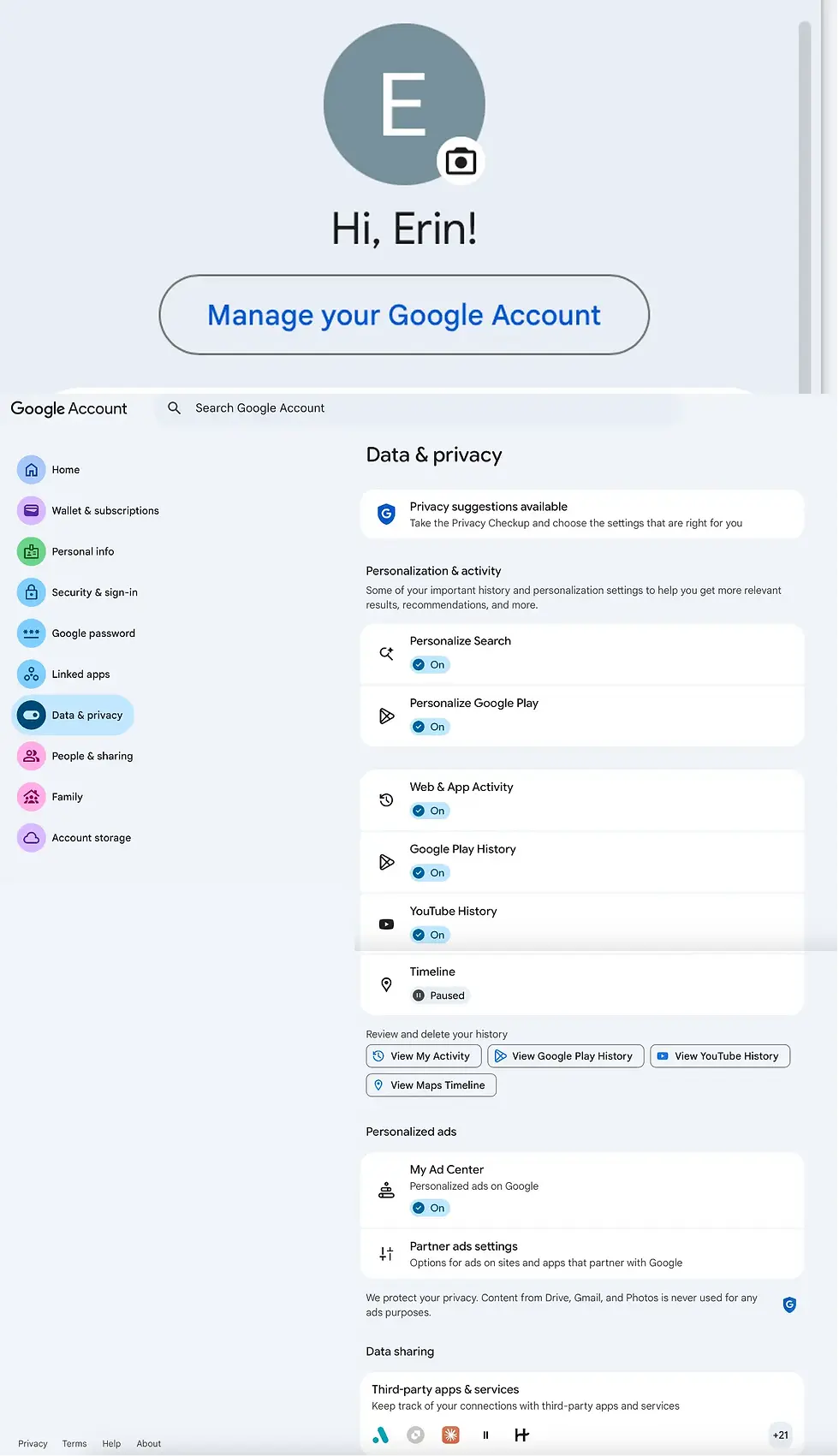
Many of Google's new search-related controls are managed through Activity Controls inside your Google Account.
How To Turn Visual Search History Off
Open your Google Account
Navigate to Data & Privacy
Open Web & App Activity
Scroll to Subsettings
Locate Visual Search History
Untick the checkbox
Changes should apply immediately.
How To Turn Voice & Audio Activity Off
Open Web & App Activity
Scroll to Subsettings
Locate Voice & Audio Activity
Untick the checkbox
Changes should apply immediately.
What this Means for Businesses
This update isn't about privacy alone. It's beginning to reveal how search itself is evolving. For years, search worked like this:
Keyword --> Search Result --> Website Click
Now, search is reshuffling itself into a new format:
Intent --> Context --> AI Understanding --> Recommendation
This changes how businesses should be thinking about visibility. Ranking for keywords still remains important, but discoverability is becoming increasingly more dependent on:
Brand authority
Content quality
Structured data
Reputation signals
Entity consistency
Digital trust

Modern discoverability depends on a network of authority signals rather than traditional rankings alone.
Why This Matters for AI Discoverability
The most important takeaway from all of these changes and evolutions is that search is becoming multimodal. Google is building systems that understand text, images, voice, video, behaviour AND context. That means that businesses can no longer rely on traditional SEO tactics alone.
Visibility is becoming an ecosystem challenge now instead, with the brands most likely to succeed being those that create strong digital authority across their websites, social platforms, reviews, structured data, media coverage and AI-readable content.
In layman's terms:
"The future of search isn't just about ranking. It's about being understood, trusted and recommended by AI systems."
This is where AI discoverability begins.

Comments